EHR Integrations

Connects to the EHRs your hospital already runs

Mediflowly integrates via HL7 FHIR R4 and ADT messaging — the standards your EHR already supports. No custom builds, no parallel data warehouse, no 6-month IT project.

Request Demo How It Works
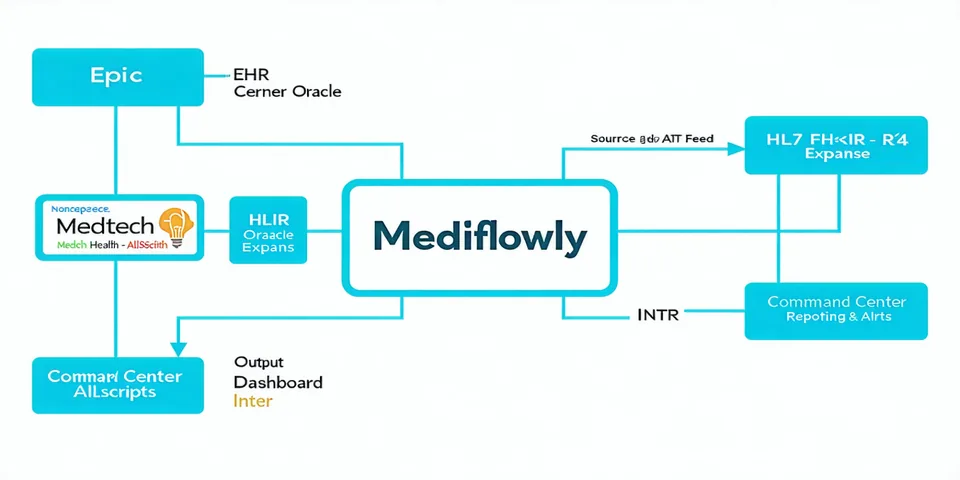
Mediflowly Platform Epic MyChart / ADT FHIR R4 Cerner Oracle Health ADT + FHIR Meditech Expanse ADT feed Allscripts Sunrise HL7 v2 HL7 FHIR R4 Standard FHIR native
Integration Details

Supported integrations

Each integration uses the EHR's native data interface — no custom API builds required from your IT team.

Epic

FHIR R4 + ADT

Connects via Epic's FHIR R4 API and ADT event feed. Mediflowly reads Encounter, Location, Appointment, and Schedule resources. Compatible with Epic versions 2018 and later. Integration reviewed against Epic's standard FHIR scope definitions.

ADT A01 ADT A02 ADT A03 ADT A08 SIU

Cerner Oracle Health

FHIR R4 + ADT

Connects via Cerner's Millennium FHIR R4 interface and HL7 ADT event stream. Compatible with both legacy Millennium and current Oracle Health branding. Reads patient encounter, admission, and scheduling data streams.

Millennium API FHIR R4 ADT events

Meditech Expanse

ADT + FHIR R4

Integrates via Meditech Expanse's HL7 ADT interface and FHIR R4 endpoint available in Expanse version 6.15 and later. Reads bed management, patient flow, and scheduling data. Common deployment at community and critical access hospitals.

Expanse 6.15+ ADT v2.x Bed management

Allscripts

HL7 v2 + API

Connects via Allscripts Sunrise's HL7 v2.x interface layer and REST API. Reads ADT messages, encounter data, and surgical scheduling feeds. Tested against Sunrise Acute Care environment.

Sunrise Acute HL7 v2.x REST API

HL7 FHIR R4

FHIR R4 Standard

Mediflowly is built FHIR-first. Any EHR with a conformant FHIR R4 endpoint can connect directly — including EHRs not listed here. Key resources used: Encounter, Location, Patient (de-identified), Appointment, Schedule, Slot.

Encounter Location Appointment Schedule

ADT Messaging

HL7 v2 ADT

Legacy HL7 v2 ADT messaging is supported as the fallback path for any EHR. All A0x event types consumed and mapped to Mediflowly's ops schema. Supports both real-time event feeds and batch file delivery patterns for constrained environments.

A01 Admit A02 Transfer A03 Discharge A08 Update
Technical Detail

HL7 FHIR R4 Native

Mediflowly's data ingestion layer is built on HL7 FHIR R4 — the current interoperability standard mandated by CMS and ONC for certified health IT systems. This means no translation middleware, no proprietary connectors, and no format negotiation for modern EHRs.

  • FHIR R4 Encounter resource maps to ED and inpatient flow events
  • Location resource provides bed, room, and unit hierarchy
  • Appointment and Schedule resources drive OR block analytics
  • All Patient resource reads use de-identified encounter IDs, not MRNs
  • Latency target: <90 seconds from EHR event to Mediflowly display
HL7 FHIR integration architecture diagram showing EHR data sources connecting to Mediflowly platform

Security architecture for EHR integration

All data in transit between your EHR and Mediflowly is encrypted with TLS 1.3. Authentication uses OAuth 2.0 / SMART on FHIR where supported, or mutual TLS certificate authentication for HL7 v2 feed connections. De-identification at ingestion ensures operational analytics do not require access to identified patient data.

Mediflowly is designed with HIPAA controls in mind. We execute a Business Associate Agreement (BAA) with all health system customers prior to integration initiation.

Full security architecture

Not seeing your EHR? Let's talk.

If your EHR supports HL7 FHIR R4 or HL7 v2 ADT feeds — and most do — Mediflowly can connect to it. Tell us your environment in the demo request.