1
Connect EHR
We establish connection via your EHR's native interface — HL7 FHIR R4 for modern EHRs, ADT event feeds for all others. No custom development from your IT team.
HL7 FHIR R4
ADT A01/A02/A08
SIU scheduling
From first EHR handshake to live operational dashboard in four weeks. No custom integration development required — we handle the data architecture.
Four stages, four weeks, zero EHR customization required from your team beyond standard API access.
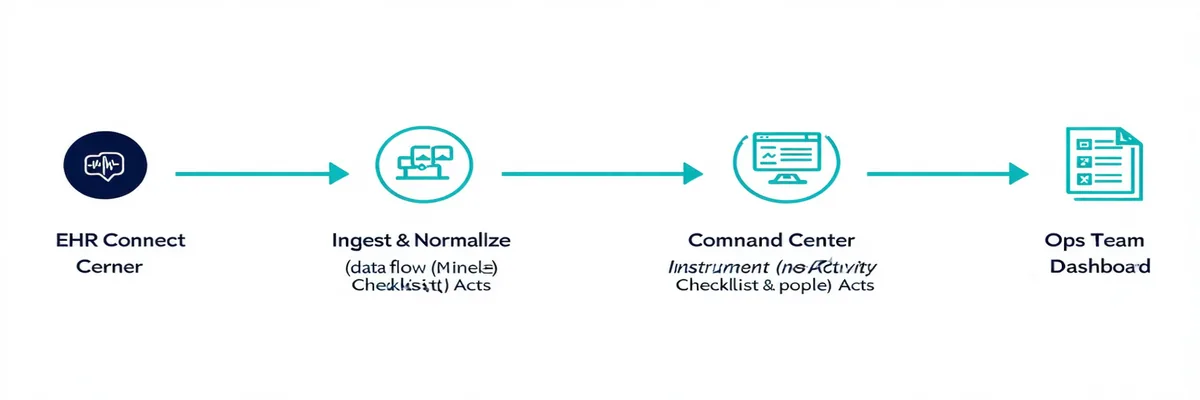
We establish connection via your EHR's native interface — HL7 FHIR R4 for modern EHRs, ADT event feeds for all others. No custom development from your IT team.
Raw HL7 and FHIR messages are normalized to Mediflowly's unified patient flow schema. Patient identifiers are de-identified at ingestion for operational analytics. All processing occurs in our TLS 1.3-encrypted pipeline.
The Mediflowly Command Center goes live for your care coordination team. ED census view, OR block utilization dashboard, and capacity grid are configured to your unit structure and shift schedules.
Charge nurses, bed management coordinators, and OR directors act on real-time data. Automated alerts trigger at configurable thresholds (boarding time, utilization drops, turnover delays).
Built for the data standards your EHR already uses. No proprietary feeds, no vendor lock-in on the data layer.
Input Layer
Supported message types: ADT^A01 (admit), ADT^A02 (transfer), ADT^A03 (discharge), ADT^A08 (update). FHIR R4 Encounter, Location, Appointment, and Schedule resources.
Processing Layer
Mediflowly's operational schema maps heterogeneous EHR data models to consistent patient flow event streams. De-identification at ingestion using Safe Harbor method. Encounter IDs replace MRNs for analytics.
Output Layer
Command center refresh every 60 seconds for operational use. Historical data retained for rolling 24-month window supporting trend analysis, benchmarking, and reporting cycles.
Mediflowly is designed with HIPAA controls in mind. Data in transit is encrypted with TLS 1.3. Data at rest is encrypted using AES-256. All user access is role-based with audit logging. We offer a Business Associate Agreement (BAA) to all health system customers.
Full security architectureNot a 12-month EHR project. A focused four-week path from signed agreement to live command center.
API credentials, FHIR endpoint configuration, ADT feed validation. IT team involvement: ~4 hours total.
Mediflowly maps your unit codes, bed labels, and physician identifiers to our ops schema. Validation review with your team.
Dashboards configured for your unit structure, shift schedules, and alert thresholds. Soft-launch to care coordination team.
Full rollout to all designated users. Reporting configured, BAA executed, 30-day post-launch support included.