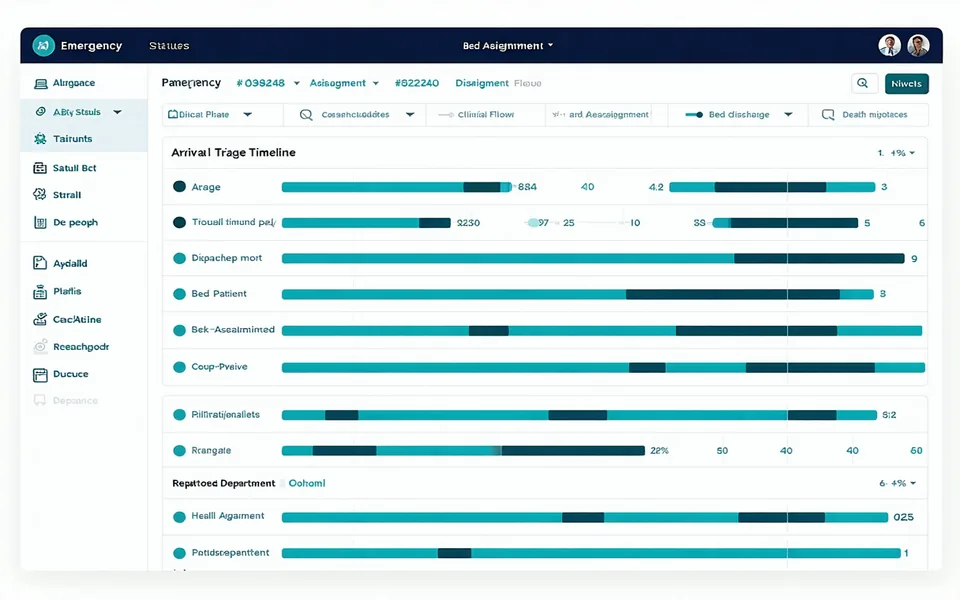
Mediflowly connects to Epic, Cerner, and Teletracking to give house supervisors at 150–600-bed regional hospitals a ranked bed-assignment recommendation — updated every 15 minutes, embedded in the workflows they already use.
Median boarding time per admitted patient at regional hospitals without real-time bed-assignment support.
First-case on-time start rates when OR scheduling data lives in disconnected systems from bed management.
Estimated downstream throughput cost for every one hour of ED boarding delay at a regional hospital.
Mediflowly recalibrates census forecasts and bed-assignment rankings every 15 minutes from live ADT and OR data.
Mediflowly is built around the bed-assignment decisions a house supervisor makes every 20 minutes. Each capability connects to that loop directly.
15-minute rolling census forecasts per unit, pulling live ADT events from Epic and Cerner. Supervisors see 4-hour and 8-hour projections with confidence intervals — early enough to pull beds before boarding begins.
Cross-references the OR case list with PACU and inpatient bed availability. Flags same-day add-ons and block releases that will create PACU holds 90–120 minutes before the conflict materializes.
Scores each available bed against each admitted ED patient by acuity, isolation flag, and unit workload. Surfaces the top three matches per patient with estimated time-to-clean from Environmental Services.
Pulls discharge-readiness indicators from Epic’s care-management module and Cerner’s care-coordination workflow 2–4 hours before the formal discharge order is written, creating a planning window for the next admission.
Two-way sync with Teletracking via a certified HL7 v2 interface. Accepted bed-assignment recommendations write back to the Teletracking bed board automatically, eliminating duplicate data entry for charge nurses.
Auto-generated at 6:45 a.m., 2:45 p.m., and 10:45 p.m.: current census, pending ED admits, confirmed OR cases, and the top three predicted capacity pinch points for the incoming shift. Delivered to Epic Hyperspace and email.
Mediflowly reads from your existing Epic and Cerner environments, runs a rolling prediction loop, and surfaces ranked bed-assignment recommendations inside the workflows your supervisors already use.
Mediflowly connects via HL7 FHIR R4 to your Epic or Cerner ADT feed, the OR schedule from Epic Surgical Services, and — if deployed — your Teletracking bed-management system. No manual data entry required.
Every 15 minutes, Mediflowly combines current census, discharge-readiness flags from care management, pending OR block releases, and historical arrival patterns calibrated per unit and day-of-week to produce an updated bed-assignment recommendation queue.
The ranked recommendation list appears as a sidebar gadget inside Epic Hyperspace — the system your supervisors are already in. No separate login, no context switch. The gadget shows projected boarding reduction and OR on-time-start probability scores.
When a supervisor accepts a bed-assignment recommendation, Mediflowly writes it back to the Teletracking bed board automatically. Environmental Services sees the assignment in their workflow. No duplicate entry, no manual reconciliation.
ED boarding is a coordination problem, not a bed-supply problem. This post examines why boarding persists despite available beds and what operational and technology changes close the gap.
Epic’s ADT feed has the data house supervisors need, but accessing it requires FHIR R4 configuration that most hospitals have not completed. Here is what the integration actually involves.
PACU overflow is rarely a recovery-room problem. It is an OR scheduling problem that surfaces downstream. This post explains how connecting the OR schedule to bed management prevents the cascade before it starts.
We work with regional health systems running Epic, Cerner, and Teletracking. Request a demo and we will walk through how Mediflowly connects to your existing environment.