OR block utilization is one of those metrics that everyone in surgical operations knows is important and almost no one is measuring consistently. The formula looks simple until you try to apply it across subspecialties, account for add-on cases, and reconcile raw time data with the political realities of who "owns" which block.
Defining Block Utilization: The Measurement Problem
Block utilization has a straightforward definition: actual OR time used in a block divided by total block time allocated, expressed as a percentage. But that definition conceals several measurement decisions that have significant downstream consequences.
First: what counts as "used" time? Most organizations use one of two approaches. The "wheels-in to wheels-out" method counts from patient entering the OR to patient leaving — this is the most conservative measure and the one most relevant to anesthesia billing. The "incision to close" method counts only surgical time. A third approach counts from case start (first-count-out) to next patient wheels-in, which effectively incorporates room turnover into utilization. Which definition you use can swing your reported block utilization by 8–15 percentage points, which is the difference between a block appearing high-performing and a block appearing underutilized.
Second: prime time vs. total block time. Most OR block structures define a "prime time" window — typically 7:00 a.m. to 3:00 p.m. or 7:30 a.m. to 3:30 p.m. on weekdays. Cases running outside prime time (late afternoons, weekends, add-on emergency slots) are generally measured separately as non-prime-time utilization. Prime-time block utilization is the metric that drives staffing costs and surgeon satisfaction because it is the window where full OR staffing is deployed.
The Block Hoarding Problem
Block hoarding occurs when a surgeon or surgical group consistently holds scheduled block time but does not fill it — and does not release unused time within the block release window, preventing other surgeons or service lines from booking into those slots. It is arguably the most common OR scheduling dysfunction in community hospitals.
The structural cause is rational behavior by individual surgeons: holding block time is a hedge against scheduling uncertainty. A spine surgeon who releases a Thursday afternoon block and then gets an urgent case can't easily reclaim the slot. The incentive structure rewards hoarding. The consequences are borne by the OR schedule overall: open time that can't be booked by other surgeons, prime-time slots sitting empty while the waiting list for other subspecialties grows.
Block release rules — policies that require surgeons to release unbooked block time a defined number of business days before the scheduled date — are the standard operational intervention. Common release windows are 7 days, 10 days, and 14 days before the scheduled block. The release window should be calibrated to the lead time your typical case type requires: a complex spine fusion may need 10+ days of preoperative prep; a routine laparoscopic cholecystectomy may book in 3 days. A single-window policy applied across all subspecialties will either over-constrain high-complexity services or under-protect low-complexity services from block hoarding.
We're not saying block release rules alone solve utilization problems — they're a necessary but insufficient intervention. Surgeons who feel their blocks are threatened will respond by scheduling cases just to hold the slot and then canceling at the last minute, which creates different downstream problems. Block governance needs to include both policy and ongoing data visibility so that surgeons and OR directors can see utilization performance by service line and have data-grounded conversations about allocation.
Prime-Time Utilization vs. Block Utilization: Why Both Matter
Prime-time utilization and block utilization are related but distinct metrics, and conflating them leads to misleading performance narratives.
Block utilization measures how well allocated block time is filled with scheduled cases. A surgeon can have 95% block utilization and still have poor prime-time performance if their cases run short, finish at noon, and leave the afternoon prime-time window empty because no add-on cases were queued. Conversely, a surgeon can have 75% block utilization but excellent prime-time performance if their shorter cases are packed tightly into the morning and afternoon is left open by design for emergency add-ons.
The metric that most directly affects OR financial performance is prime-time utilization — the percentage of prime-time hours that are actually generating case revenue. Industry benchmarks from organizations like the Advisory Board and published literature in Anesthesiology suggest that community hospitals typically operate at 65–75% prime-time utilization, with high-performing systems reaching 80–85%. Anything below 65% is a signal that either block allocation is mismatched with actual demand, or that first-case on-time start failures are eroding the early prime-time window.
First-Case On-Time Start: The Gateway Metric
First-case on-time start (FCOTS) — the percentage of first scheduled cases of the day that begin within a defined tolerance (usually 15 minutes) of the scheduled start time — is perhaps the single most visible OR performance metric to both surgeons and staff. It sets the tone for the entire block schedule. A 7:30 a.m. case that starts at 8:05 a.m. compresses every subsequent case in the block by 35 minutes, which may push the last case into overtime territory with associated staffing cost penalties.
In a representative scenario at a 250-bed regional health system operating 12 OR suites: FCOTS was running at approximately 62%, meaning more than a third of first cases started late. Root cause analysis revealed three roughly equal contributors: late patient arrival at the preoperative holding area (patient flow from registration and pre-op prep), missing or incomplete H&P documentation that required physician completion before anesthesia consent could be confirmed, and anesthesia provider delays due to late pre-procedure case reviews. Each of these root causes requires a different operational fix — better preoperative appointment reminder workflows, documentation completion gates at the posting cutoff, and earlier anesthesia case assignment — and none of them is solved by the OR charge nurse calling people to hurry up.
Subspecialty Performance: Where the Variation Hides
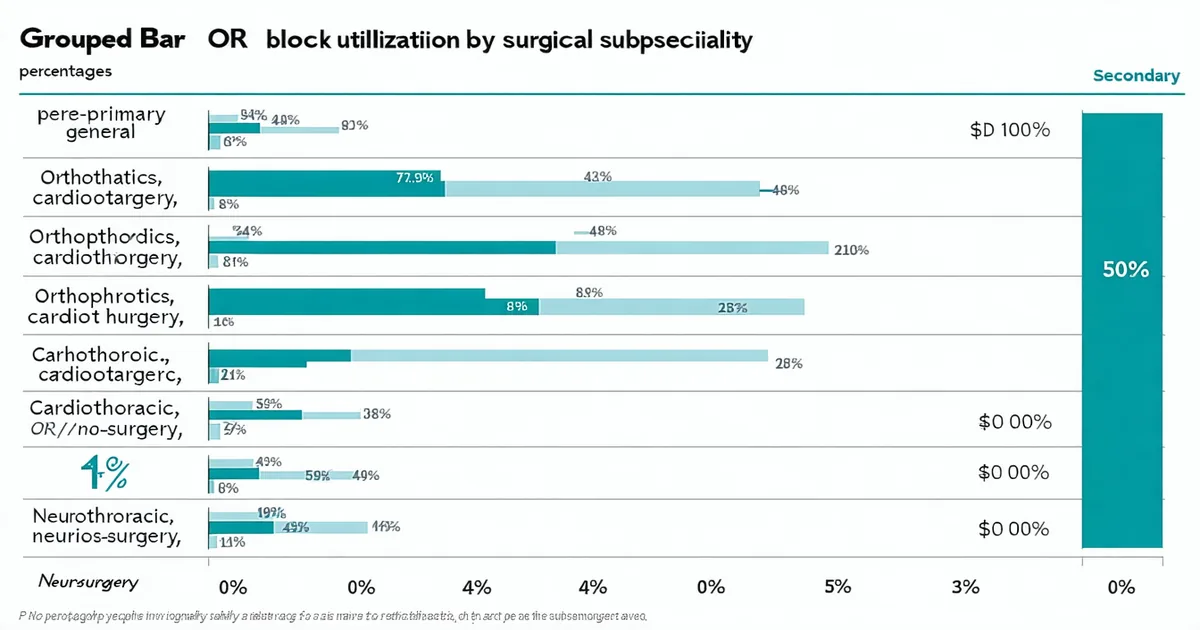
Aggregate OR utilization numbers can mask dramatic variation at the subspecialty level. A hospital reporting 74% overall prime-time utilization might be carrying orthopedics at 88%, general surgery at 79%, and neurosurgery at 51% — a 37-point range. Neurosurgery's low utilization may be driven by case duration variance (brain tumor cases that are scheduled for 4 hours and run 6 hours, cascading block delays), by geographic patient referral patterns that make case volume inherently lumpy, or by a single high-volume surgeon who hasn't adapted their scheduling patterns to block release rules.
Subspecialty-level block utilization reporting is the foundation of productive OR governance conversations. When an OR director says "we have a utilization problem," the meaningful response is: which services, which days, and which component of the metric — scheduled time not filled, cases running short, or block time not released? Each answer points to a different governance action.
Getting Your OR Data into a Usable State
In Epic environments, OR scheduling and case duration data lives in OpTime, with analytic reporting available through Cogito. Cerner Oracle Health stores equivalent data in SurgiNet. Both systems generate the raw events — case scheduled, patient wheels-in, incision time, close time, patient wheels-out — that feed utilization calculation. The challenge is that native EHR reporting often requires significant configuration to produce the subspecialty-level, day-of-week-disaggregated, release-window-adjusted utilization views that OR governance needs.
Mediflowly's OR module is designed to ingest OpTime and SurgiNet scheduling events and normalize them into block utilization, prime-time utilization, FCOTS, and room turnover time dashboards — calibrated to your specific block structure and prime-time definition. If you want to understand what your current subspecialty utilization picture looks like before committing to a governance redesign, request a demo to see how the data maps.