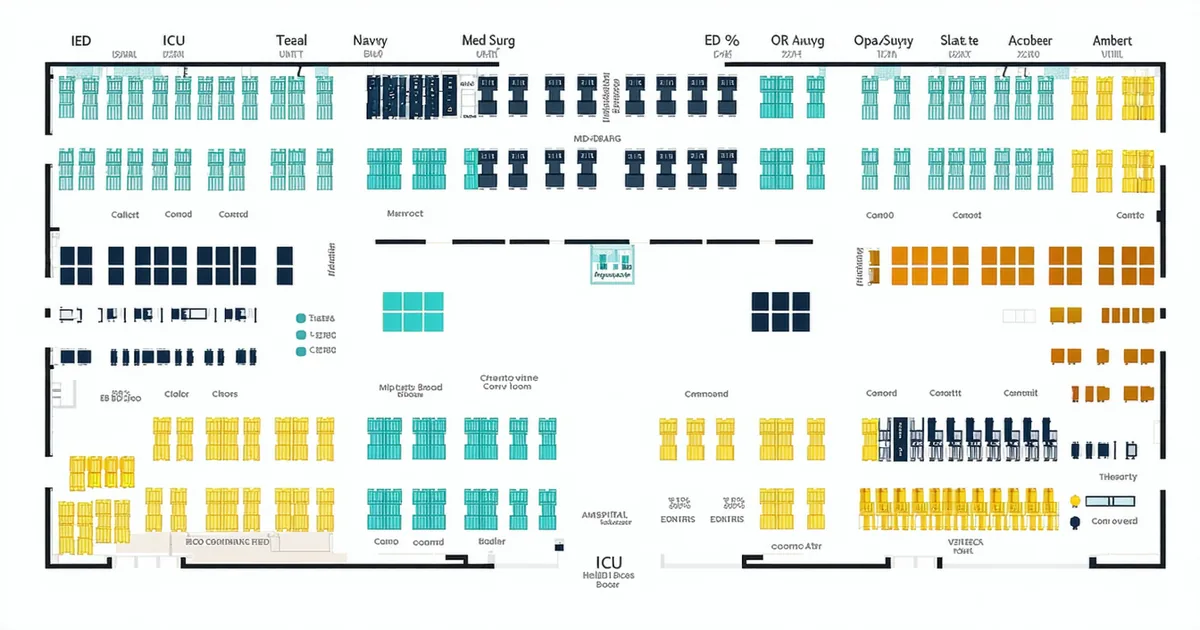
The term "capacity command center" has accumulated a certain mythology in hospital operations circles — associated with large academic medical centers, elaborate multi-screen visualization walls, and multi-million dollar technology investments. The reality of what makes a command center function effectively is considerably more practical, and the model is accessible to regional health systems that don't have academic medical center resources.
What a Capacity Command Center Is — and Isn't
A capacity command center — sometimes called a bed management center, patient placement center, or mission control — is a centralized function that coordinates patient movement across the hospital in real time. Its core responsibilities are: maintaining an accurate, current view of hospital census; managing bed assignments for ED-to-inpatient admissions, direct admissions, and inpatient transfers; coordinating with nursing units, EVS, and patient transport to move patients efficiently; and escalating capacity constraints to operational leadership when census approaches critical thresholds.
A command center is not defined by the size of its display screens or the sophistication of its predictive models. It is defined by whether a small team has the information, authority, and operational processes needed to make and execute bed placement decisions across the hospital without requiring nursing units to manage placement independently. The centralization of the placement function — combined with real-time data visibility — is the source of throughput improvement, not the technology itself.
We're not saying technology is unimportant — accurate, timely data is what makes a command center team effective rather than just busy. We're saying that organizations that invest in command center technology without redesigning the placement authority and escalation workflows often end up with an expensive dashboard that doesn't change how decisions are made on the floor.
Staffing Models: What the Evidence Supports
Command center staffing varies significantly by hospital size, census patterns, and the scope of functions centralized. A common model for a 200–350 bed regional health system involves a dedicated bed management role (often a Bed Coordinator or Patient Placement Coordinator) staffed during peak hours (typically 6 a.m.–10 p.m.) with on-call coverage overnight. This role may be filled by experienced nurses, nurse supervisors transitioning to coordination roles, or purpose-hired patient flow specialists depending on the organization's workforce model.
At larger systems (400+ beds, multiple campuses), command center staffing expands to cover: bed management coordination, centralized patient transport dispatch, discharge planning oversight, and potentially a clinical resource nurse who can support nursing units experiencing capacity or staffing pressure. Some health systems centralize ED boarding management in the command center, with a dedicated coordinator whose sole function during peak hours is tracking ED-to-inpatient transfer status and escalating delays.
The staffing investment is justified by the reduction in time-consuming phone coordination across units. In a hospital without centralized bed management, a bed control function operating by phone averages 8–15 calls per placement cycle across nursing units, EVS, patient transport, and the admitting team. A command center with real-time data visibility reduces that to 2–4 contacts per placement. Across 50–80 daily movements, that arithmetic produces meaningful staff time savings and faster placement cycles.
Real-Time vs. Predictive Data: The Right Balance
Command center technology discussions often center on predictive capabilities — census forecast models, predicted discharge times, demand surge prediction. These capabilities have genuine value, but their value is conditional on having solid real-time data as a foundation.
The sequence matters: a command center that knows accurately what its census is right now, which beds are dirty, which discharges have pending orders, and which ED patients have been waiting for more than 60 minutes is operationally functional. A command center that has a predictive census model but doesn't have reliable real-time bed status data is working from a forecast layered on top of an inaccurate current picture — which can be worse than no forecast at all if the prediction confidence is treated as higher than warranted.
For regional health systems beginning a command center implementation, the practical recommendation is to solve the real-time data problem first: ensure that ADT feeds are flowing accurately, that bed status updates are happening without manual intervention, and that the command center team can trust the current-state census view before investing in predictive analytics layers.
Predictive census models — typically built on historical arrival patterns by hour of day and day of week, case mix seasonality, and observed discharge timing — add genuine value once the real-time foundation is solid. They allow command center teams to anticipate census pressure 4–8 hours in advance and begin proactive discharge acceleration and bed preparation before the pressure point arrives, rather than responding reactively when the ED is already boarding three patients.
Data Requirements for an Effective Command Center
The minimum data requirements for a functional command center are: current bed status by unit (occupied, dirty, clean-available, pending maintenance), current census by unit with bed type breakdown (M/S, telemetry, step-down, ICU), patients with active discharge orders and anticipated departure times, admitted patients waiting for bed placement with wait time since admission order, and ED census with boarder count and average boarding time.
In Epic environments, this data is derivable from ADT feeds (A01/A02/A03/A08 events) combined with bed management status events. In Cerner Oracle Health environments, equivalent data flows through the ADT pipeline with similar event structure. The challenge for most hospitals is that this data exists across multiple systems — EHR ADT for patient location, a separate EVS system for bed cleaning status, potentially a separate patient transport system for movement requests — and is not aggregated in a single view without an integration layer.
A practical scenario: a 280-bed regional health system launching a command center pilot operated on a combination of the EHR-native bed board (for patient placement) and manual EVS status updates (via walkie-talkie). The bed coordinators reported that approximately 20% of their placement delays were caused by not knowing which rooms were in EVS cleaning versus clean-but-not-yet-updated in the system. Connecting the EVS notification workflow to the bed management view reduced that ambiguity and measurably shortened placement cycle times. The improvement came from data integration, not from the sophistication of the analytics.
Common Implementation Failure Modes
Based on the operational experience of health systems that have implemented command center models — and the published literature on capacity management program outcomes — the most common implementation failure modes are predictable:
- Authority without data: Command center teams are given placement responsibility but not the data access needed to exercise it effectively. They end up making placement decisions by phone, replicating the fragmented process they were supposed to replace.
- Data without authority: The command center has excellent visibility but no authority to make placement decisions without nursing unit approval. Nursing units retain veto power over placements, creating a two-step process that adds latency rather than reducing it.
- Insufficient nursing unit engagement: Command center implementations launched without floor nursing buy-in result in passive resistance — units report census inaccurately, delay discharge notification, or bypass the command center by calling the admitting team directly. The centralization model only works if the decentralized behaviors that it replaces are genuinely retired.
- Overinvestment in display technology: Large-format video wall installations with real-time dashboards are visually impressive but don't substitute for the data integration and process redesign that actually drive performance. Several health systems have invested significantly in command center infrastructure only to find that the room runs on four browser windows and a phone — which works fine if the data behind those windows is accurate and actionable.
Getting Started: A Phased Approach
For regional health systems that are considering a command center model but haven't yet invested in a formal implementation, a phased approach that starts with data infrastructure before physical command center buildout typically yields better outcomes than starting with the physical space.
Phase one establishes real-time ADT integration and a centralized bed management dashboard that your existing bed coordinator function can use. Phase two formalizes the command center role with clear authority and escalation protocols. Phase three adds predictive analytics capabilities once the real-time foundation is stable. The physical command center space can develop organically rather than requiring a capital project as a precondition for operational improvement.
Mediflowly's platform is designed to support this phased approach — providing the real-time census and bed management data foundation that makes command center operations effective, without requiring a large upfront implementation commitment. If you want to understand what a command center data architecture looks like in your specific EHR environment, request a demo.