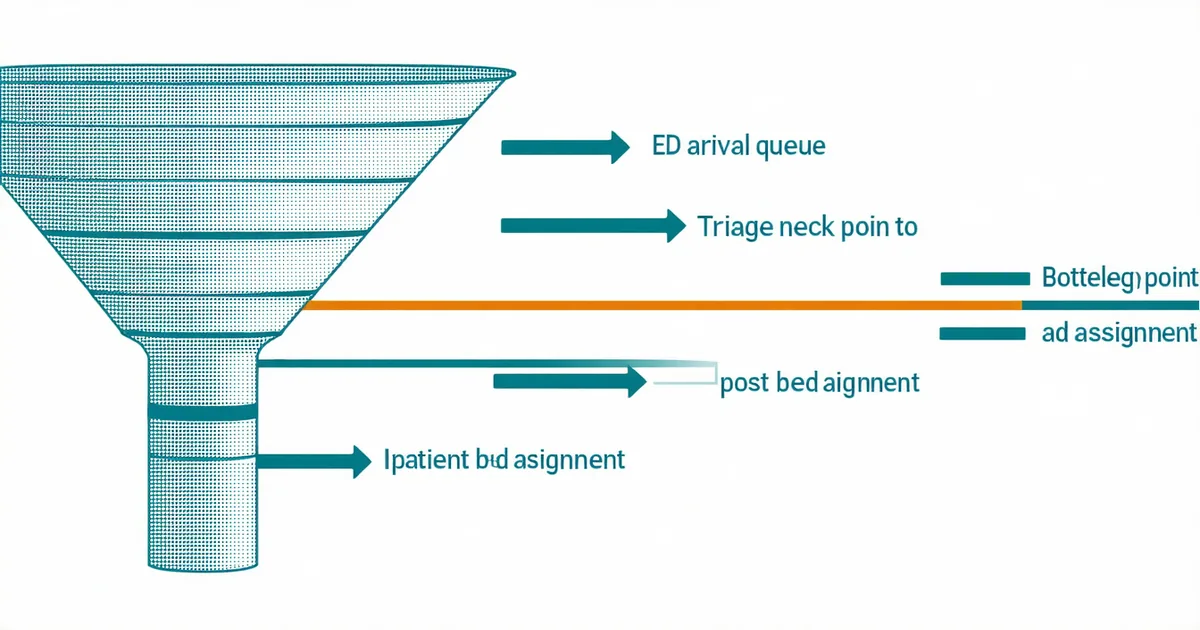
ED boarding is routinely described as an "emergency department problem" and addressed with ED-side interventions — more triage staff, fast track expansion, team triage models. The clinical operations literature has known for more than a decade that this framing is wrong. Boarding is an inpatient capacity problem that manifests in the ED. Treating it in the ED is like treating the symptom and ignoring the disease.
Boarding vs. Overcrowding: A Critical Distinction
ED boarding and ED overcrowding are related but distinct phenomena, and conflating them leads to misallocated interventions.
ED overcrowding is a situation where patient volumes exceed the ED's ability to provide timely care — where acuity-adjusted demand outstrips triage, physician, and bed capacity within the department itself. Overcrowding is primarily an ED-side problem and is addressed by ED-side solutions: adding provider hours during peak periods, implementing split-flow models that separate low-acuity patients from high-acuity workup patients, or expanding the physical ED footprint.
ED boarding is a situation where the ED is holding patients who have been assigned an inpatient bed but cannot be physically transferred because no inpatient beds are available. These patients — the boarders — occupy ED beds while awaiting an inpatient room, preventing those ED spaces from being used for new incoming patients. Boarding is caused by downstream inpatient capacity constraints, not by anything happening in the ED itself. Adding triage staff or expanding the fast track does nothing for a patient who has been admitted for an acute MI and is waiting for a telemetry bed that won't free up until afternoon discharges occur.
The distinction matters operationally because organizations that misidentify boarding as overcrowding continue investing in ED-side capacity while the inpatient floor dynamics that actually drive boarding go unaddressed.
The Inpatient Drivers of Boarding
ED admit hold time — the interval from admission order to physical transfer to an inpatient bed — is the operational measure of boarding burden. When admit-to-bed times average over 90 minutes systemwide, it is almost always attributable to one or more of three inpatient-side conditions:
- Discharge clustering in the afternoon: When attending physicians round in the late morning and write discharge orders between 11 a.m. and 1 p.m., beds don't free up until 2–4 p.m. after EVS cleaning. This creates a daily demand-supply mismatch that predictably loads the ED with boarders during morning and early afternoon hours.
- Bed allocation mismatches: Admitted patients requiring specific bed types (telemetry, step-down, isolation) face longer waits even when the hospital's overall census has available beds, because the available beds are not the right type. A hospital at 85% overall occupancy may have zero open telemetry beds and six open general medical-surgical beds — the ED patient requiring cardiac monitoring waits, while a patient needing a routine M/S bed moves quickly.
- Insufficient real-time census visibility: Bed control functions operating on information that is 30–60 minutes stale make bed allocation decisions based on an inaccurate picture. Beds that became available after the last manual update aren't being assigned; beds that have been verbally allocated but not formally confirmed are double-counted as available.
Measuring Boarding Time: What Goes Into the Number
Boarding hours are not consistently defined across hospitals, which makes benchmarking difficult. Some organizations count boarding as any time beyond a threshold (often 2 hours) from admission decision to physical transfer. Others count from the moment an inpatient bed is assigned to when the patient physically arrives in that bed. Still others measure from the admission order to physical departure from the ED space.
For operational improvement purposes, the most actionable definition is: boarding hours = sum of time all admitted patients spent in ED beds after admission order, measured from admission order to departure from ED census. This definition captures the total ED boarding burden in patient-hours rather than a per-patient average, which is more useful for capacity planning. A hospital with 15 daily admitted patients and an average 2.5-hour admit-to-bed interval has 37.5 patient-hours of daily boarding burden — that is more than a single ED bed fully occupied for an entire shift just absorbing admitted patients waiting for inpatient placement.
Hallway Beds and the Limits of ED Workarounds
When ED boarding reaches a critical threshold, patient flow coordinators and ED charge nurses resort to hallway beds — placing patients in stretchers in corridors and alcoves outside of exam rooms. This is sometimes described as a "vertical patient model" variant, but that terminology is misleading. A true vertical patient model places ambulatory low-acuity patients in chairs or standing treatment spaces to accelerate their throughput cycle. Hallway beds for admitted boarders are neither vertical nor a throughput model — they are a safety compromise made necessary by capacity failure.
We're not saying that eliminating hallway beds is a simple operational fix — many hospitals face real physical capacity constraints during surge events that make some hallway use unavoidable. We're saying that when hallway beds are used daily rather than only during genuine surge events, the root cause is almost always the inpatient discharge-admission timing mismatch, not ED volume or ED process failure. ACEP has formally opposed hallway boarding as a standard operational approach, and the patient safety implications — reduced nursing assessment frequency, less monitoring access, higher adverse event risk — are well documented in the emergency medicine literature.
Real-Time Census Visibility as the Operational Lever
The intervention that most consistently moves boarding metrics is not ED-side — it is real-time census visibility for bed management, combined with structured bed huddles that reconcile expected discharges against pending admissions with adequate lead time.
Consider the operational sequence at a hospital without real-time census visibility: the ED has three admitted patients waiting for M/S beds. Bed control calls the floor charge nurse, who checks visually and reports two patients "probably going home this afternoon." Two hours later, one of those patients has a clinical deterioration and won't be discharged. Bed control learns about this via a phone call at 2 p.m. and has to restart the bed search with two patients still boarding. The entire delay was caused by stale information.
With an ADT-driven real-time census view, discharge orders are visible to bed control at the moment they are signed. Bed control can see not just census counts by unit but which specific patients have discharge orders pending, which have anticipated departure times, and which have care progression barriers still outstanding. This changes the bed allocation conversation from a phone-tag loop to a structured matching process.
HL7 ADT A03 discharge events, A01 admit events, and A02 transfer events feed this real-time picture when properly ingested and displayed. In Epic environments, the Bed Board module provides this natively when configured; in environments where EHR bed board coverage is incomplete, an ADT-fed operations platform fills the gap.
The Bed Allocation Mismatch Problem
Even hospitals with good real-time census visibility encounter bed allocation mismatches — situations where beds exist but aren't the right type for the patient waiting. A 310-bed health system operating a telemetry unit with 36 beds and a step-down unit with 24 beds will routinely find that on high-census days, both specialty units are full while general M/S units have availability. This is a structural issue, not a visibility issue, and it requires a different set of interventions: flex bed protocols that allow telemetry-capable rooms to serve as overflow step-down for certain patient populations, clinical criteria for step-down graduation, and proactive census management that anticipates specialty bed crunches before they become boarding events.
Connecting Inpatient Operations to ED Boarding Reduction
The operational programs that demonstrate sustained boarding reduction address both the real-time visibility problem and the discharge planning timing problem simultaneously. Real-time census visibility without earlier discharge planning doesn't change the demand-supply timing mismatch — it just makes bed control more accurately aware of a gap they still can't close until afternoon. Earlier discharge planning without real-time visibility leads to discharge targets that aren't coordinated with bed control's actual placement needs.
The combination — evening bed huddles that identify next-day discharge candidates and care progression barriers, morning discharge coordination rounds, and a real-time census dashboard that keeps bed control informed continuously — is what produces meaningful admit-to-bed reduction. It is also the workflow that Mediflowly's capacity command center is built to support. If you want to understand how the data flows connect in your specific EHR environment, we'd welcome a conversation.