Hospitals invest heavily in clinical protocols, staffing models, and EHR optimization — and then lose 25–40 minutes per patient transition to a process that receives almost no operational attention: the time between a discharge order and a clean, ready bed.
Why Bed Turnover Is a Throughput Problem First
The term "bed turnover" is sometimes treated as a facilities or housekeeping metric — something Environmental Services (EVS) owns. In practice, it is one of the most consequential throughput variables in a hospital. Every minute a bed sits in a "dirty" or "pending clean" state while an admitted patient waits in the ED, a post-anesthesia care unit patient waits for a floor bed, or a surgical patient waits for an overnight room, is a minute that propagates delay through the entire system.
Consider a hospital with 50 ED-to-inpatient transfers per day and an average bed request-to-clean lag of 65 minutes. If operational improvements reduce that lag to 45 minutes — a 20-minute reduction — the compounded effect across 50 daily transitions is roughly 1,000 minutes of patient wait time recaptured per day, or the equivalent of nearly 17 hours of ED boarding capacity. That arithmetic is why experienced patient flow directors treat EVS coordination as a capacity planning function, not a facilities function.
The Anatomy of Bed Turnover Time
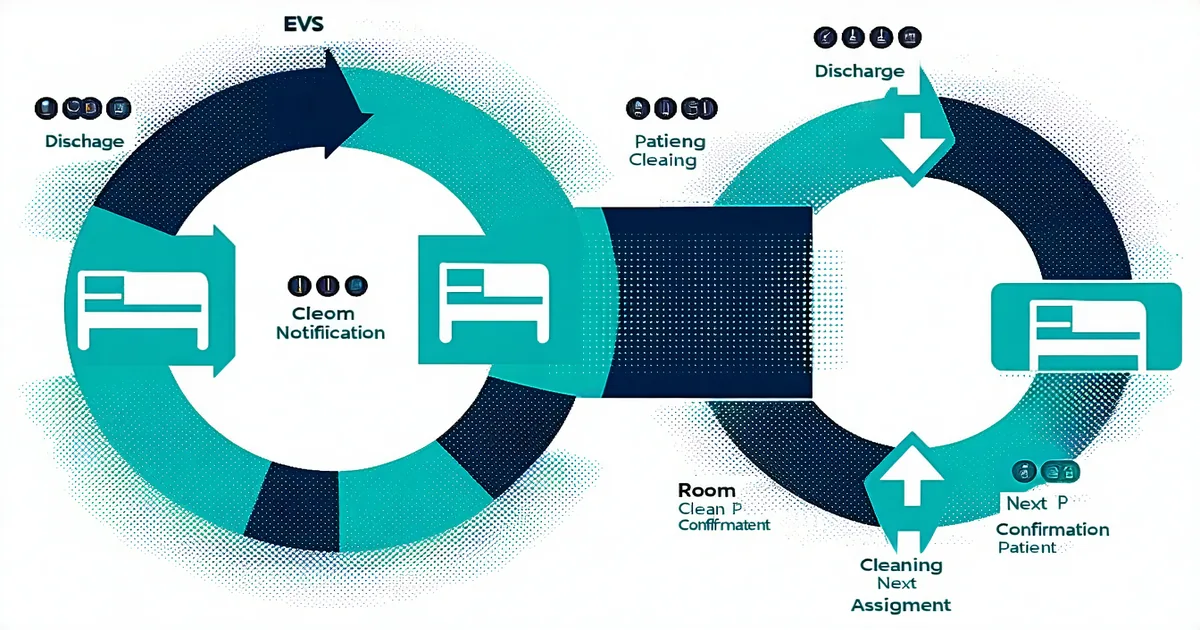
Bed turnover time — the interval from patient discharge to a clean bed available for the next patient — breaks into three sub-intervals, each with a different operational owner:
- Discharge order to EVS notification: The time between the physician signing the discharge order and the EVS team receiving notification that the room needs cleaning. In hospitals without automated ADT-triggered notifications, this interval often runs 10–20 minutes as nursing staff manually call or radio EVS. In Epic environments using ADT event-driven workflows, this can be reduced to near-zero by triggering a work order at discharge event A03.
- EVS notification to clean start: The time between EVS receiving the notification and an EVS aide entering the room to begin cleaning. This interval is determined by staffing ratios, current EVS queue depth, and prioritization logic. During high-census periods, EVS teams may have 8–12 rooms pending simultaneously and no structured protocol for which to prioritize.
- Clean time to bed-ready notification: The actual room cleaning time plus the time for the unit charge nurse or bed control coordinator to be notified that the room is ready. Standard room turnover for a typical medical-surgical bed runs 20–30 minutes of active cleaning. The notification lag after cleaning completes is often where invisible time loss occurs — EVS aides may complete a room and not communicate "clean" status for 5–10 minutes.
The total bed request-to-clean cycle ranges from roughly 35 minutes in well-run systems to over 90 minutes in systems with fragmented communication between nursing, bed control, and EVS. The difference is almost entirely in the first and third sub-intervals — not in cleaning time itself, which is relatively fixed.
Communication Fragmentation: The Root Cause
Most bed turnover problems trace to communication fragmentation between three parties that rarely share a common system view: the nursing unit discharging the patient, the EVS department receiving the work request, and the bed control function managing overall hospital census.
Take a plausible operational scenario: a 220-bed community hospital with an ED that runs at 90%+ occupancy during peak hours. Nursing staff on a medical-surgical floor call the EVS dispatch line when a patient discharges. EVS dispatchers log the request in a paper-based or whiteboard queue. Bed control, sitting in a separate room, has no visibility into which rooms are pending clean or how long they have been waiting. When a bed control coordinator needs to place a new admission from the ED, they call the unit charge nurse, who calls EVS, who checks the queue — a three-party information relay that adds another 5–10 minutes per placement cycle.
This is not an unusual scenario. It describes standard operations at many community hospitals that haven't invested in real-time EVS workflow integration. The fix is not complex, but it requires connecting ADT discharge events to EVS task management, and surfacing EVS queue status in the same bed management view bed control uses.
What EVS Integration Actually Looks Like in Practice
We're not saying that EVS workflow software is a silver bullet — standalone EVS systems that aren't connected to bed management and ADT feeds can actually add complexity without adding visibility. The value is in the integration, not the tool itself.
Effective EVS coordination in a patient flow context has three characteristics. First, discharge events in the EHR automatically generate EVS work orders without human intermediary steps — this requires either native EHR workflow configuration (Epic's Housekeeping module, for instance) or an HL7 ADT A03 discharge event feeding an EVS dispatch system. Second, bed control has a real-time view of EVS queue status by unit — how many rooms are pending, how long each has been waiting, and which are in progress. Third, when a room is marked clean, the notification triggers an update in the bed management view, not just in the EVS system, so bed control can proactively assign the next admission without polling.
Hospitals using this integrated model typically report bed request-to-clean times in the 35–50 minute range. Hospitals without it typically see 60–90 minutes. The gap is 20–40 minutes per transition — and it compounds across every patient movement in the building.
OR Turnover Time: The Parallel Challenge
The same EVS coordination dynamic plays out in the operating room, with higher stakes per incident. OR room turnover — the interval from one case's patient leaving the room to the next patient entering — includes EVS cleaning as one component alongside equipment restocking, linen changes, and positioning setup. Standard room turnover targets at community hospitals run 25–35 minutes. When EVS is the rate-limiting step, turnover times climb to 40–55 minutes, which cascades into delayed subsequent case starts, surgeon dissatisfaction, and direct revenue impact from lost prime-time OR utilization.
OR-side EVS coordination is often separated organizationally from inpatient EVS — OR EVS teams frequently report to the OR director rather than facilities management. This means the same communication fragmentation problems that affect inpatient bed turnover appear in the OR context, but with even less tolerance for delay since prime-time OR minutes are expensive to waste.
Measuring Bed Turnover Time: Getting the Data Right
Before you can improve bed turnover time, you need to measure it accurately — and the measurement is less straightforward than it seems. The ideal measurement is: timestamp of discharge order in the EHR minus timestamp of bed-ready notification in the bed management system. Both of these events should be derivable from ADT feeds (A03 for discharge, with a corresponding bed-status event when the bed transitions to available). In practice, many organizations measure only cleaning time — from EVS entering the room to EVS marking it clean — which omits the notification lag on both ends and systematically undercounts the actual patient-impacting interval.
When Mediflowly ingests ADT data, we surface bed turnover intervals at the unit level, identifying which nursing units have the longest request-to-clean cycles and flagging units where the notification-to-EVS-dispatch lag is the primary driver. This shifts the conversation from "EVS is slow" to "our notification workflow has a 15-minute gap we can close with a configuration change."
If you're working to establish a baseline for bed turnover improvement and want to understand how your EHR data maps to the measurement framework, get in touch — we're happy to walk through the data model before any commercial conversation.